

.webp "Potentiometer 10Kohm")
.webp "10K Potentiometer")
.webp "Potentiometer EC fan")
.webp "10K potentiometer EC motor")

Datasheet
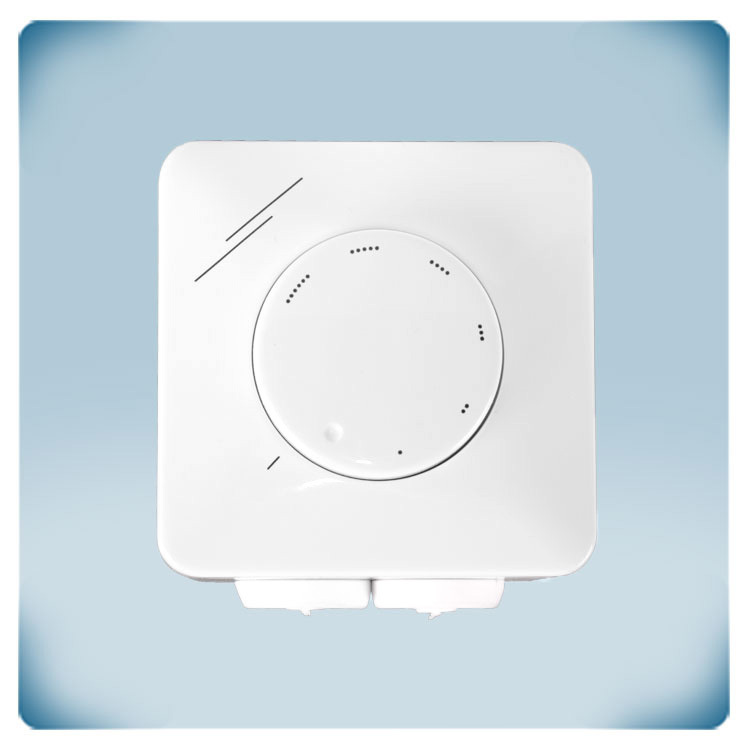
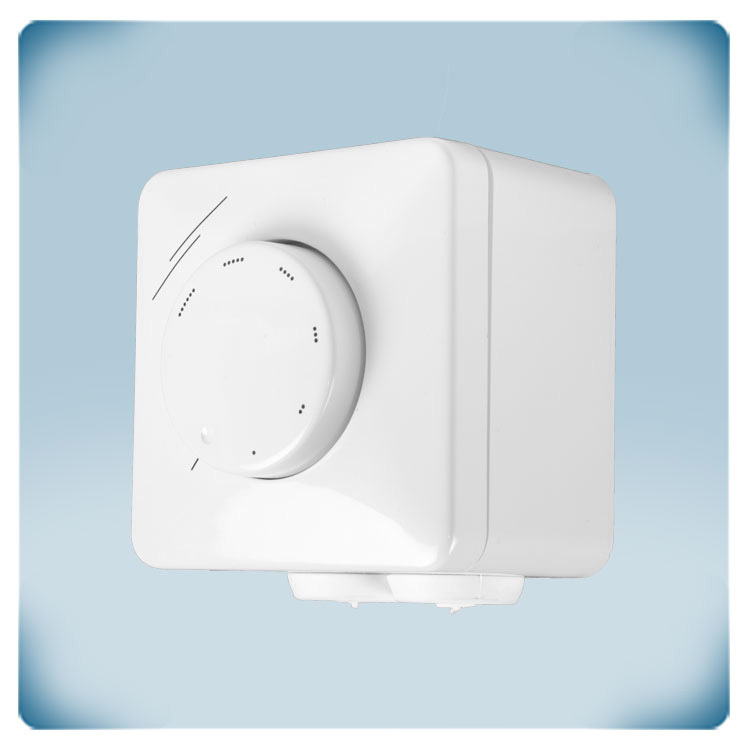
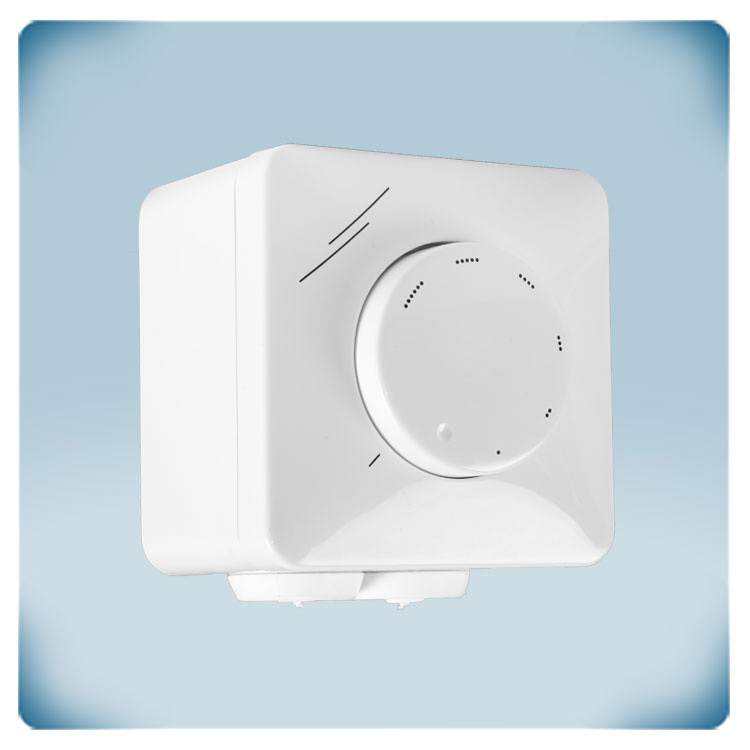
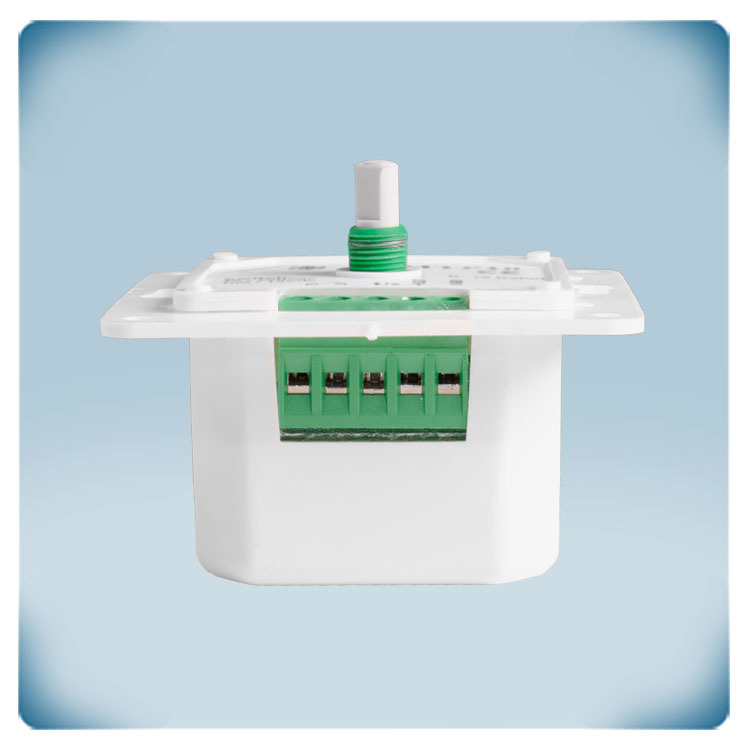
Potentiometer 10K | dry contact output | OFF position
Product description
This 10 kΩ potentiometer can directly control EC fans. For AC motor speed control, it can be connected to an Electronic Fan Speed Controller (EVS, MVS) or frequency converter (FI-E). The potentiometer has an adjustable resistance of 0—10 kΩ.
The device does not require a specific power supply, but the input signal must be between 0 and 12 VDC. Most EC fans, electronic speed controllers and frequency converters provide an output with the required voltage. Depending on the knob position, the feedback voltage varies, thereby regulating the fan speed. The dry contact output can be used to provide a remote start/stop command to the fan or other equipment.
The splash-proof enclosure allows both inset installation (IP44) and surface mounting (IP54).

Additional specifications and description
How does it work?
The resistance output value (0—10 kΩ) of this potentiometer is adjusted via the rotary button. The control output can directly control EC fans or damper actuators. It can also remotely control AC fan speed controllers (such as Sentera’s EVS or MVS series) or variable frequency drives (FI-E series). This potentiometer can be installed away from the device it controls — be it a fan speed controller or an EC fan — while the controlled device may be located in a technical room or an electrical cabinet.
This is a potentiometer for remotely controlling devices with an analogue input. The analogue control signal has a maximum voltage of 12 VDC / 1 mA. The desired output voltage is adjusted steplessly from 0 to the supply voltage V using the rotary button. This potentiometer can handle input voltages in the range of 0 to 12 VDC. It has a resistance output value of 0—10 kΩ.
What is the purpose of the dry contact output?
A dry contact output is a widely used method for controlling external devices and interfacing with different systems. The term "dry contact" is often used to emphasise the absence of an electrical current or voltage source in the output. Its simplicity and compatibility make it a practical choice in various applications, including industrial automation, building management systems, security systems and more.
The dry contact output of the MTPNX10K-NA serves the purpose of controlling an external device, such as a damper, or facilitating the activation and deactivation of a motor. Rotation of the potentiometer knob fully anticlockwise results in an open dry contact, while turning it clockwise closes the contact, thereby regulating the associated equipment.
The resistance output value (0—10 kΩ) of this potentiometer is adjusted via the rotary button. The control output can directly control EC fans or damper actuators. It can also remotely control AC fan speed controllers (such as Sentera’s EVS or MVS series) or variable frequency drives (FI-E series). This potentiometer can be installed away from the device it controls — be it a fan speed controller or an EC fan — while the controlled device may be located in a technical room or an electrical cabinet.
This is a potentiometer for remotely controlling devices with an analogue input. The analogue control signal has a maximum voltage of 12 VDC / 1 mA. The desired output voltage is adjusted steplessly from 0 to the supply voltage V using the rotary button. This potentiometer can handle input voltages in the range of 0 to 12 VDC. It has a resistance output value of 0—10 kΩ.
What is the purpose of the dry contact output?
A dry contact output is a widely used method for controlling external devices and interfacing with different systems. The term "dry contact" is often used to emphasise the absence of an electrical current or voltage source in the output. Its simplicity and compatibility make it a practical choice in various applications, including industrial automation, building management systems, security systems and more.
The dry contact output of the MTPNX10K-NA serves the purpose of controlling an external device, such as a damper, or facilitating the activation and deactivation of a motor. Rotation of the potentiometer knob fully anticlockwise results in an open dry contact, while turning it clockwise closes the contact, thereby regulating the associated equipment.
What is the advantage of the OFF position?
The rotary knob has an OFF position: when the rotary knob is turned completely anticlockwise, it clicks in OFF position. In OFF position, the dry contact output is open. In that position, the resistance output value is 0 kΩ. That means that the output will be 0 Volt in this position.
How to install this potentiometer?
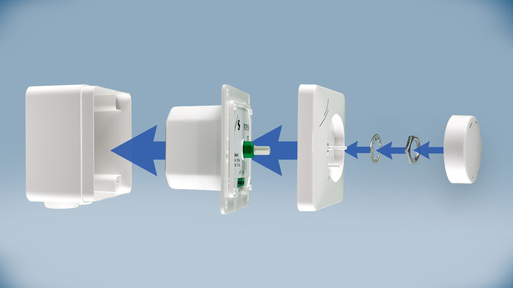
This potentiometer offers an exceptional simplicity of installation, featuring proven technology and design. Thanks to its special enclosure design, this potentiometer is fit for both surface and flush mounting, which means that you can install it on or in any kind of wall — a solid wall, drywall or even a wood panel. The mounting holes fit perfectly the standard European wall boxes used for flush mounting. There is no need to opt for two different product versions as this potentiometer combines both of them. The protection class is IP44 for flush and IP54 for surface mounting. Furthermore, its design blends well with a wide range of interior styles. Cleaning it is very easy using only a damp cloth.
The screw terminal block simplifies the process of connecting wires. The screw terminals allow for secure and reliable connections without the need for soldering, making installation more straightforward. They accommodate a wide range of wire types and facilitate maintenance and repairs. If a connection needs to be adjusted or replaced, this can be done in the field without specialised tools or equipment.
Only a few basic tools and general technical knowledge are required to install the potentiometer.
Remarks, reviews & ratings