

How to adjust parameters of a Sentera device?
All parameters of Sentera devices can be read and adjusted via Modbus RTU communication. These parameters can be subdivided into Input registers and Holding registers. Input registers are read-only. They contain information that can be read, but they cannot be modified. For example, this information can show the current temperature and humidity levels. These parameters cannot be modified because they are the actual value of what is being measured.
The values of the Holding registers can be changed. Settings that determine the functionality of the device are usually included in the Holding registers. For example, the values of the minimum damper position angle and the maximum damper position angel can be set in the Holding registers, alongside other numerous parameters, depending on the type of your device.
For a complete overview of all parameters, consult the Modbus register map of the device.
To facilitate configuration and monitoring of your Sentera device, we advise you to use one of following options:
SenCom software
SenCom is the Sentera configuration software that also makes it possible to update firmware of the connected devices. SenCom offers a convenient way to manage Sentera devices connected to a local computer. It is a user-friendly, browser-based configuration tool for all Sentera devices with Modbus RTU communication.
SenCom can be accessed via following link.
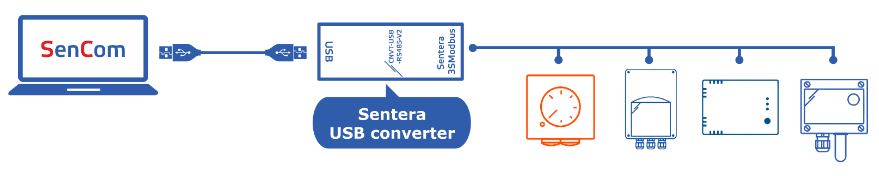
No software installation is required as the application works directly in a web browser. Once SenCom has been loaded, it can even work offline. It allows users to adjust settings, monitor devices and update firmware locally. A USB converter is required to connect the Sentera devices to a computer. Multiple devices can be connected simultaneously.
With SenCom, it is possible to:
- Configure parameter settings of connected devices
- Monitor connected devices
- Update device firmware
- Log data and visualise it in diagrams
- Export logged data as a CSV file
SenteraWeb HVAC cloud
You can monitor, adjust and log your connected products with our online HVAC portal SenteraWeb. Via a Sentera internet gateway, you can connect Sentera device(s) to SenteraWeb. You can connect the gateway via Wi-Fi connection or through a LAN cable. The Sentera internet gateway serves as a gateway between the Sentera devices (interconnected via Modbus RTU) and the SenteraWeb cloud environment. Multiple devices can be connected simultaneously.
You can monitor, adjust and log your connected products with our online HVAC portal SenteraWeb. Via a Sentera internet gateway, you can connect Sentera device(s) to SenteraWeb. You can connect the gateway via Wi-Fi connection or through a LAN cable. The Sentera internet gateway serves as a gateway between the Sentera devices (interconnected via Modbus RTU) and the SenteraWeb cloud environment. Multiple devices can be connected simultaneously.
You can use SenteraWeb via a standard web browser (e.g. Google Chrome, MS Edge etc.) without the need to install additional software on your computer. You can connect to your installation remotely by just using a web browser and an internet connection. Brand new products and products with the latest firmware versions can also be connected to SenteraWeb since it is an online platform, which uses the most recent databases. Additionally, the connected devices can even undergo firmware updates. The parameters of the connected products are visually presented in SenteraWeb. The Input registers are read-only and cannot be modified, while the Holding registers can be adjusted according to your desired values. An overview of all parameters of our devices is available for download on the page of each product on our website.

When the installation is configured, you can choose to remove the internet gateway and use the installation stand-alone. However, by choosing to continue using the internet gateway, you can take advantage of additional features and functions that are only available in SenteraWeb.
With SenteraWeb, you can:
- Configure parameter settings of connected devices
- Monitor connected devices
- Update device firmware
- Log data and view it in diagrams
- Export logged data as a CSV file
And you also can: - Receive alert messages or warnings via email or SMS in case threshold values are exceeded
- Use the day-week scheduler to set specific value ranges at certain moments of the day / week and overrule other output values at predefined times
- Define different users and configurators for each installation
- Create your own, personalised dashboard for your installation
- Print a QR code that gives everyone access to see the dashboard of your installation. This makes it possible to give people insights in the indoor air quality inside a restaurant, shop, etc.