

.webp "Air quality duct sensor")
.webp "VOC duct sensor")

EU declaration conformity
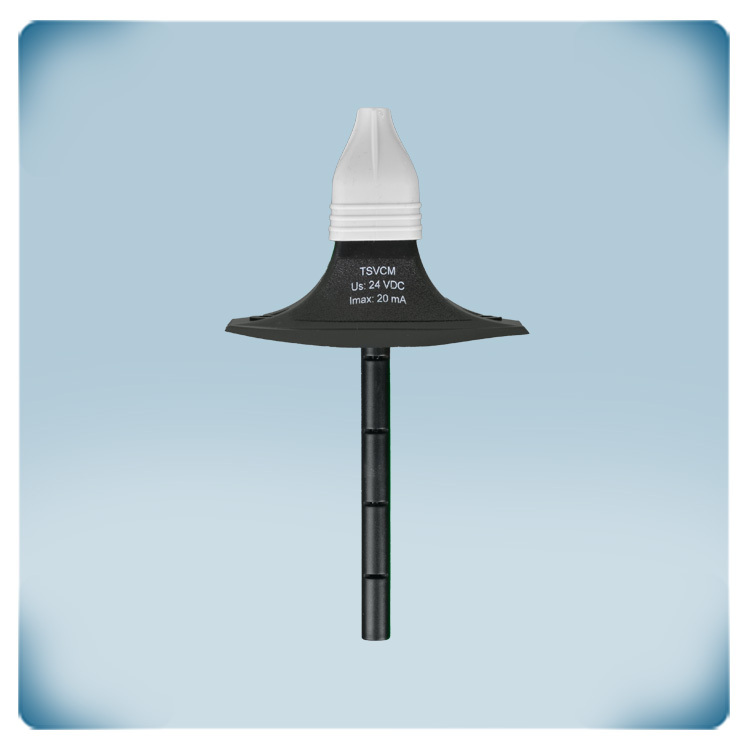
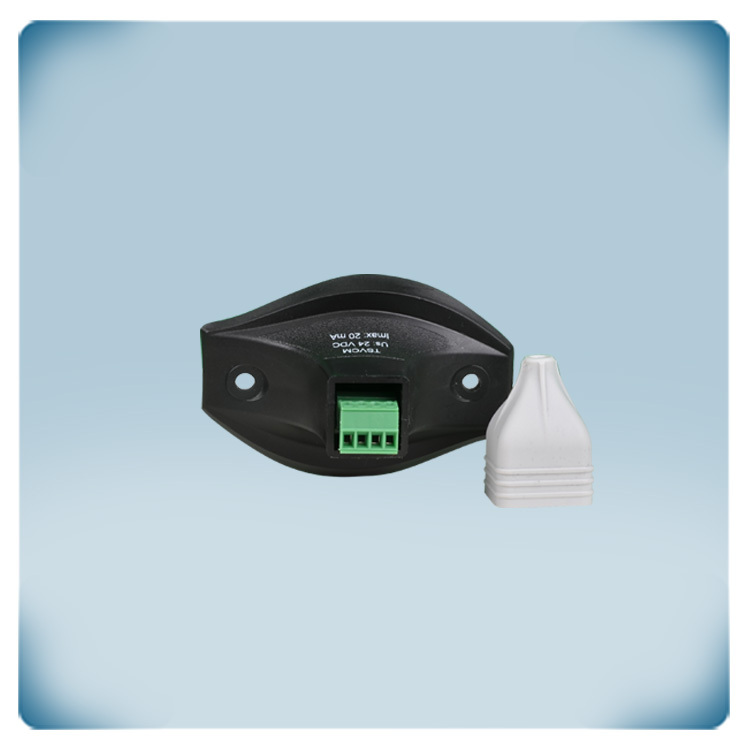
T, RH and VOC sensor | Duct | 24 VDC
Product description
Measures VOC Index, temperature, and relative humidity in air ducts.
Power Supply: Operates on 24 VDC.
Modbus RTU Communication: All measured values and device settings are accessible via Modbus RTU communication.
No Analogue Outputs: The sensor operates without analogue outputs.
Easy Integration: Designed for measuring VOC Index, temperature, and relative humidity in air ducts.
Indoor Installation: Features a premium plastic enclosure with IP20 protection and is designed for indoor use.


Additional specifications and description
Which Parameters Are Measured and Why Is It Important?
This sensor is designed for monitoring indoor air quality in air ducts. It measures temperature, relative humidity and the VOC index. The VOC Index provides a simplified, dynamic overview of total VOC (TVOC) levels in indoor air and serves as a smart indicator of indoor air quality. It reflects trends in VOC-related air pollution. A reference value of 100 represents the average indoor air composition over the previous 24 hours. Values between 100 and 500 indicate deteriorating air quality, while values between 1 and 100 indicate improving conditions. The index continuously adapts to its environment and helps detect both deterioration and recovery of indoor air quality over time. When the VOC Index shows a downward trend, fan speed can be reduced. In case of an upward trend, more fresh air supply is required to wash away the pollutants.
VOC Index: A Simple Measure of Indoor Air Quality
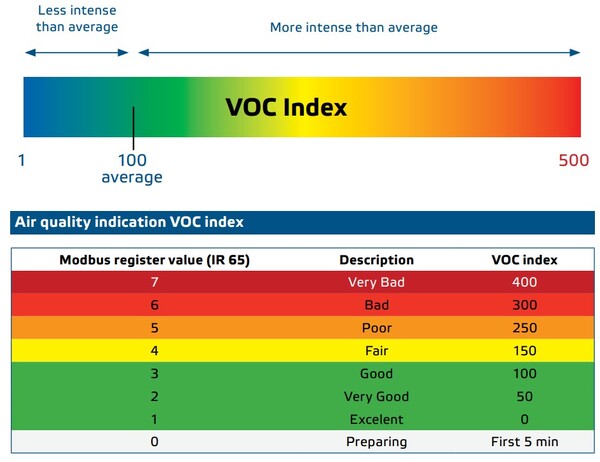
The VOC Index provides a simple indication of indoor air quality on a scale from 1 to 500, with 100 representing the average VOC level. Values below 100 indicate cleaner-than-average air, while higher values indicate increasing VOC levels and poorer air quality. The index ranges from Excellent to Very Bad and can help demand-controlled ventilation systems automatically adjust airflow to maintain a healthier and more comfortable indoor environment.
What Are the Configuration and Customisation Options?
This sensor requires little configuration and can be used almost immediately once it has been installed. The sensor has no analogue outputs. All measured values can be accessed through the Modbus input registers. They can be read via SenteraWeb, our online HVAC platform, via a BMS system, or any other Modbus master device. Modbus communication offers several advantages. Digital signals are less prone to interference than analogue signals, and much longer cables - up to 1000 metres - can be used.
How Is the Sensor Installed, and What Are the Power and Connectivity Requirements?
The sensor is designed for installation in indoor air ducts. The plastic sensor probe has a length of 85 mm. For optimal performance, the sensor should be placed in a straight section of the duct. Avoid installing the sensor near filters, fans, cooling coils, or other sources of turbulent airflow. Make sure the sensor is positioned correctly according to the airflow direction. For more information, please refer to the mounting instructions.
The supply voltage is 24 VDC, with a maximum current consumption of 20 mA. Both the supply voltage (V+ and GND) and Modbus RTU communication (A and B) are connected via a pluggable screw terminal block. This pluggable screw terminal block simplifies installation, since the cable can be connected at an easily accessible location and then the connector can be plugged into the sensor. A 4-wire cable (Cat5 or EIB) is required to connect this sensor.
What Are the Sensor’s Quality, Durability and Protection Features?
All sensors are designed and manufactured in Europe. Each device is calibrated and tested in the factory. Only high-quality components are used, ensuring long-term stability and accuracy.
The enclosure is produced in-house by Sentera Plastics from premium ABS. It is designed for indoor use and offers IP20 protection against the ingress of dust and moisture. To ensure optimal performance, the sensor should be protected from direct sunlight. The sensing element is housed within a plastic sensor probe, which includes an opening that allows airflow to come into direct contact with the sensor element.
Read more about enhancing your indoor air quality:

Remarks, reviews & ratings