

How to measure air volume flow and air velocity?
To ensure that a ventilation system supplies sufficient fresh air and efficiently removes stale air, both air volume flow and air velocity need to be measured and controlled.
Bernouilli’s principle
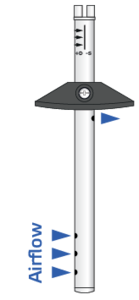
The formulas used to calculate air velocity and airflow are based on Bernoulli’s principle, which describes the relationship between the speed of a moving fluid, such as air or water, and its pressure.
In simple terms, it states that an increase in air velocity results in an increase in dynamic pressure and a decrease in static pressure. A Pitot tube measures the difference between total pressure and static pressure. This differential pressure, or dynamic pressure (caused by movement), increases with air velocity and can be used to calculate air velocity.
How to calculate air velocity?
Air velocity (v) indicates how fast the air moves through the duct and is expressed in m/s. In ventilation systems, air velocity is typically measured by combining a differential pressure sensor with a Pitot tube.
The sensor measures the differential pressure created by the airflow inside the duct. Based on this pressure difference and the air density, the air velocity can be calculated.
Formula air velocity
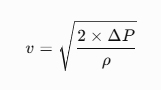 or
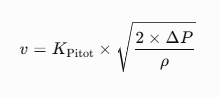
Which parameters are required?
-
- ΔP = Differential pressure [Pa]: the difference between the pressure outside (static pressure) and inside the duct (dynamic pressure).
- ρ = Air density [kg/m³]: the density of the air flowing through the duct. This is typically 1.2 kg/m³ under normal indoor conditions.
- KPitot = K-factor of the Pitot tube: a fixed, dimensionless correction coefficient that accounts for the characteristics of the Pitot tube and its influence on the measured air velocity. It is provided by the manufacturer.
How to calculate air volume flow?
Air volume flow (Q) indicates how much air passes through the duct over time and is expressed in m³/h. Air volume flow is measured by connecting a connection set to the differential pressure sensor.
Based on the measured differential pressure and the K-factor of the fan, the air volume flow can be calculated.
If the fan's K-factor is unknown, air volume flow can be calculated based on the air velocity (measured by a pitot tube) and the cross-sectional area of the duct.
Formula air volume flow
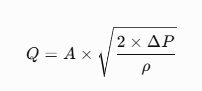 or
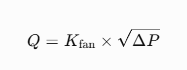
Which parameters are required?
-
- ΔP = Differential pressure [Pa]: the difference between the pressure outside (static pressure) and inside the duct (dynamic pressure).
- Kfan = K-factor of the fan: a fan-specific constant that takes into account the characteristics of the fan inlet ring and relates the differential pressure across a fan to the air volume flow rate it produces. It is provided by the manufacturer.
- A = Duct cross-sectional area [mm²]: the internal area of the duct.
- ρ = Air density [kg/m³]: the density of the air flowing through the duct. This is typically 1.2 kg/m³ under normal indoor conditions.
Differential pressure sensors, controllers and accessoires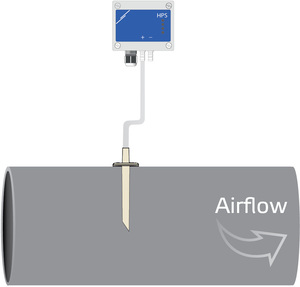
Sentera differential pressures sensors (HPS- and DPS-series) measure the pressure difference [Pa] inside the air duct. Regulating airflow, on the other hand, requires differential pressure controllers (HPSP-, HPSA-, DPSP-, DPSA-, or SPS2-series).
Based on these measurements, air volume flow [m³/h] or air velocity [m/s] can be calculated.
To enable these calculations, optional connection sets are required to connect the sensor to the air duct:
- Set types PSET-PVC-200 or PSET-QF-200 measure differential pressure. When the K-factor of the fan is known, the sensor can calculate the air volume flow.
- Set types PSET-PTS-200 or PSET-PTL-200 measure air velocity. When the cross-sectional area of the duct is known, the sensor can calculate the air volume flow.
Explore our range of differential pressure sensors and controllers for ventilation and HVAC applications.