

How does a nondispersive infrared (NDIR) CO2 sensor work?
Nondispersive infrared (NDIR) sensing technology is the most widely used method for measuring CO2 concentrations in an environment. NDIR sensors use an infrared (IR) lamp, typically a LED, which sends waves of light into a chamber filled with ambient air. The air inside the tube moves toward an optical filter, which is set up in front of the IR light detector (photodiode). The detector measures the amount of light that can pass through the filter.
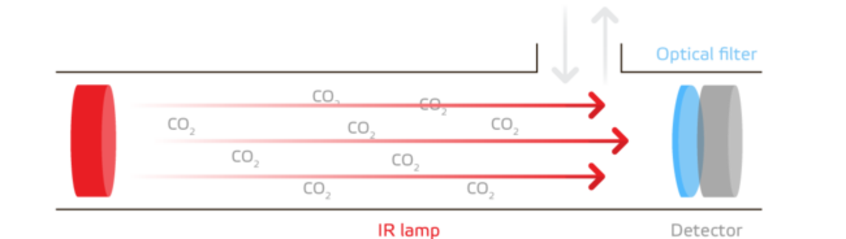
This is an accurate indicator of the CO2 concentration in the air sample: the CO2 molecules absorb infrared light. However, only light with a wavelength of 4.26 µm will be absorbed; other wavelengths are allowed to pass through. The remaining light hit the optical filter.
- This nondispersive infrared band-pass filter only allows the infrared wavelengths of interest to pass ensuring that the receiver only detects the IR light with the relevant frequency band.
- The detector reads out how much of the infrared light of the wavelength that CO2 molecules can absorb, was not blocked by CO2 molecules in the tube.
- The sensor then calculates the difference between the amount of light that the infrared lamp emitted and the amount of light that the detector received. This difference is an accurate representation of the amount of CO2 molecules in the air sample because the CO2 molecules have absorbed the “missing” light.
A reference intensity at a known CO2 concentration is used to determine the CO2 level in the air sample.
This measurement is converted to micro voltages, which can be converted to different outputs, such as values, but also output control signals such as an analogue 0–10V-signal or (digital) Modbus RTU-communication.
Advantages of NDIR sensors
NDIR sensors have minimal interference of other gases, low life-cycle cost and precise and stable long-term operation.
They are durable with a lifespan of up to 15 years.
NDIR sensors have minimal interference of other gases, low life-cycle cost and precise and stable long-term operation.
They are durable with a lifespan of up to 15 years.
Disadvantages of NDIR sensors
NDIR sensors typically consist of a light emitter and an optical detector positioned at opposite ends of a specially designed optical cavity. These sensors typically require a minimum optical path length of several centimeters between the light emitter and receiver to ensure sufficient IR light absorption for accurate measurement of lower CO2 concentrations. This is a limiting factor in making the sensors more compact and restricts the use of NDIR sensors in certain applications.
NDIR sensors typically consist of a light emitter and an optical detector positioned at opposite ends of a specially designed optical cavity. These sensors typically require a minimum optical path length of several centimeters between the light emitter and receiver to ensure sufficient IR light absorption for accurate measurement of lower CO2 concentrations. This is a limiting factor in making the sensors more compact and restricts the use of NDIR sensors in certain applications.
Furthermore, mechanical and thermal stresses on the measurement chamber can significantly affect CO2 readings.
The Sentera CO2 duct and outdoor sensors are based on this principle.
Photoacoustic Spectroscopy (PAS) is another type of CO2 sensor based on the light absorption principle.