

How does a photoacoustic spectroscopy (PAS) CO2 sensor work?
Photoacoustic spectroscopy (PAS) sensors use the same working principle of the absorption wavelengths but unlike the NDIR sensors that measure the receiving light from an emitting LED, PAS sensors measure the absorption with a microphone.
The IR light source is pulsed, meaning it turns on and off at regular intervals. This pulsing is crucial for generating the acoustic signal needed for detection. As the light passes through the gas, CO2 molecules absorb specific wavelengths, leading to molecular vibrations. The absorption process causes the CO2 molecules heat up and expand periodically, creating pressure fluctuations or acoustic waves in the surrounding air.
A microphone captures these sound waves. The amplitude of the acoustic signal is directly related to the concentration of CO2 in the sample.
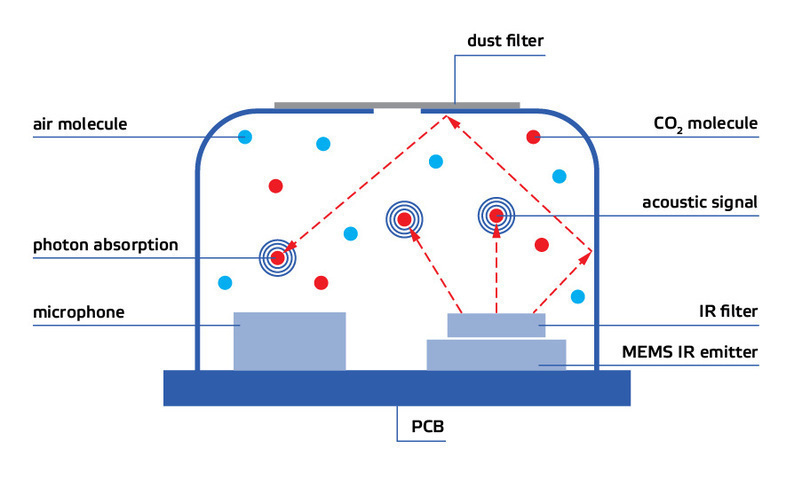
Higher CO2 concentrations result in stronger absorption of IR light, leading to more significant molecular vibrations and, consequently, larger pressure waves.
The acoustic signal detected by the microphone is processed by the sensor's electronics. The signal's amplitude is analysed to determine the CO2 concentration. Advanced algorithms are used to filter out noise and ensure accurate measurements.
PAS sensors represent a powerful tool for monitoring CO2 levels across various applications. They are ideal for environmental monitoring, indoor air quality assessment, greenhouse management, and industrial applications.
Advantages of PAS sensors
PAS sensors have minimal interference of other gases, high sensitivity, rapid response time, and a wide dynamic range.
PAS sensors have minimal interference of other gases, high sensitivity, rapid response time, and a wide dynamic range.
Another major advantage is the possibility to create a compact and portable design. In contrast with NDIR sensors, the design of PAS sensors is not sensitive to the precise alignment of optical components. Sound waves are omnidirectional, meaning the relative positioning of the IR emitter and the microphone is not as critical.
This makes photoacoustic sensors suitable for applications where space is limited and makes them also more robust to mechanical and thermal stresses. They can be highly sensitive to small changes in CO2 concentration, providing accurate readings even at low concentrations.
The Sentera CO2 room sensors all use this type of sensing technology.
Nondispersive Infrared (NDIR) is another type of CO2 sensor based on the light absorption principle.