


Schematic overview
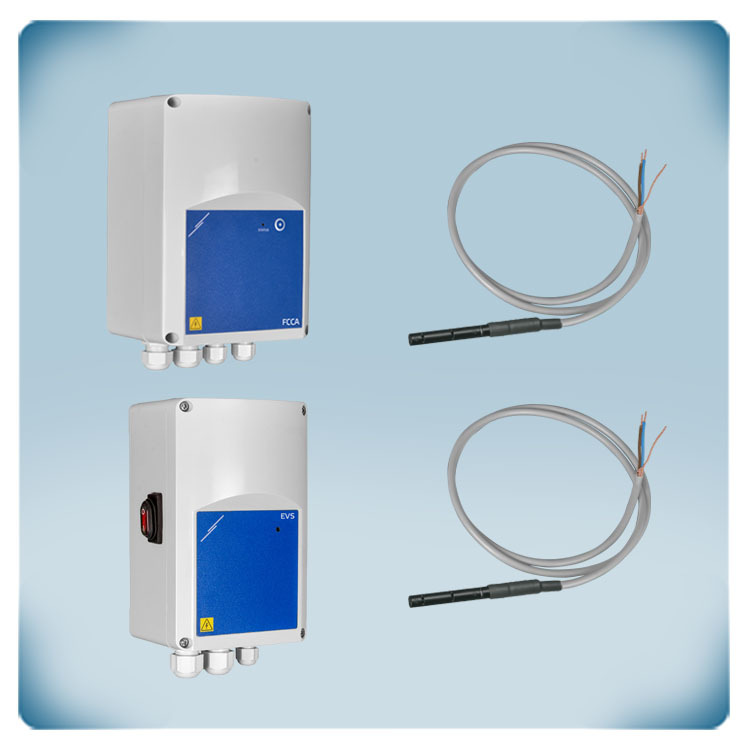
Free cooling | AC fans | 10 A | IP54
Solution description
Free cooling is achieved using exhaust and supply fans equipped with AC motors, with a maximum total current of 10 A. The free cooling controller uses PT500 sensors to measure both outdoor and indoor temperature. Based on these measurements, the controller generates a 0–10 V analogue output signal and sends it to the AC fan speed controller. The speed controller adjusts the rotational speed of the exhaust and supply fans, introducing cooler outdoor air into the room while removing warmer indoor air.
Additional specifications and description
How does free cooling work?
The free cooling controller uses two PT500 temperature sensors to measure indoor and outdoor temperatures and calculate the temperature difference. When the indoor temperature exceeds the configured set point and the temperature difference exceeds the adjustable threshold, free cooling is activated. The controller then regulates the ventilation fans to introduce cooler outdoor air and remove warmer indoor air, reducing the indoor temperature.
Can free cooling save energy?
Why use energy-intensive air conditioning when cooler outdoor air can do the job? Free cooling uses the natural temperature difference between indoor and outdoor air to remove excess heat from a building.
A dedicated controller monitors indoor and outdoor temperatures and automatically activates the ventilation fans when conditions are suitable for cooling. This reduces the need for air conditioning, lowers energy consumption and operating costs, and improves the energy efficiency of industrial buildings and warehouses.
How are AC fans controlled?
The free cooling controller sends an analogue control signal to the electronic AC fan speed controller, which adjusts the fan speed accordingly.
This speed controller is designed for single-phase, voltage-controllable AC motors with a specified maximum current. It regulates the rotational speed by varying the voltage supplied to the motors.
Which sensors should be used with the free cooling controller?
The controller is designed to operate exclusively with PT500 sensors. Sentera offers several versions to meet different customer requirements.
Depending on the application, the available options include sensors with a metal or plastic probe and various cable lengths, as well as room sensors for measuring indoor temperature.
Remarks, reviews & ratings