

What types of CO2 sensors exist?
Carbon dioxide (CO2) is a natural component of the air and a key indicator of indoor air quality. Since CO2 mainly originates from human respiration, its concentration reflects how intensively a space is used and how much fresh air is available. By using real-time CO2 measurements, ventilation can be controlled precisely to supply sufficient fresh air, prevent CO2 build-up, and maintain a healthy indoor environment.
CO2 measurement
Gases absorb light at specific wavelengths and this absorption forms the basis of several gas-sensing technologies. Light is emitted at a certain wavelength that the target gas can absorb. Based on the detected — optical or acoustic — signal, the concentration of the gas can be calculated. To measure CO2, the light is tuned at a wavelength close to 4.26 μm, which corresponds to the absorption of CO2.
Nondispersive Infrared (NDIR) and Photoacoustic Spectroscopy (PAS) are two types of CO2 sensors based on the light absorption principle.
Nondispersive infrared sensing technology
Nondispersive infrared (NDIR) sensing technology is the most widely used method for measuring CO2 concentrations in an environment. NDIR sensors use an infrared (IR) lamp, typically a LED, which sends waves of light into a chamber filled with ambient air. The air inside the tube moves toward an optical filter, which is set up in front of the IR light detector (photodiode). The detector measures the amount of light that can pass through the filter.
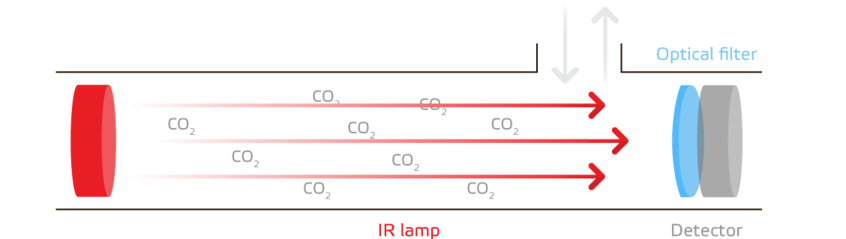
This is an accurate indicator of the CO2 concentration in the air sample: the CO2 molecules absorb infrared light. However, only light with a wavelength of 4.26 µm will be absorbed; other wavelengths are allowed to pass through. The remaining light hit the optical filter.
- This nondispersive infrared band-pass filter only allows the infrared wavelengths of interest to pass ensuring that the receiver only detects the IR light with the relevant frequency band.
- The detector reads out how much of the infrared light of the wavelength that CO2 molecules can absorb, was not blocked by CO2 molecules in the tube.
- The sensor then calculates the difference between the amount of light that the infrared lamp emitted and the amount of light that the detector received. This difference is an accurate representation of the amount of CO2 molecules in the air sample because the CO2 molecules have absorbed the “missing” light.
A reference intensity at a known CO2 concentration is used to determine the CO2 level in the air sample.
This measurement is converted to micro voltages, which can be converted to different outputs, such as values, but also output control signals such as an analogue 0–10V-signal or (digital) Modbus RTU-communication.
The Sentera CO2 duct and outdoor sensors are based on this principle.
Advantages of NDIR sensors
NDIR sensors have minimal interference of other gases, low life-cycle cost and precise and stable long-term operation.
They are durable with a lifespan of up to 15 years.
NDIR sensors have minimal interference of other gases, low life-cycle cost and precise and stable long-term operation.
They are durable with a lifespan of up to 15 years.
Disadvantages of NDIR sensors
NDIR sensors typically consist of a light emitter and an optical detector positioned at opposite ends of a specially designed optical cavity. These sensors typically require a minimum optical path length of several centimeters between the light emitter and receiver to ensure sufficient IR light absorption for accurate measurement of lower CO2 concentrations. This is a limiting factor in making the sensors more compact and restricts the use of NDIR sensors in certain applications. Furthermore, mechanical and thermal stresses on the measurement chamber can significantly affect CO2 readings.
NDIR sensors typically consist of a light emitter and an optical detector positioned at opposite ends of a specially designed optical cavity. These sensors typically require a minimum optical path length of several centimeters between the light emitter and receiver to ensure sufficient IR light absorption for accurate measurement of lower CO2 concentrations. This is a limiting factor in making the sensors more compact and restricts the use of NDIR sensors in certain applications. Furthermore, mechanical and thermal stresses on the measurement chamber can significantly affect CO2 readings.
Photoacoustic spectroscopy sensing technology
Photoacoustic spectroscopy (PAS) sensors use the same working principle of the absorption wavelengths but unlike the NDIR sensors that measure the receiving light from an emitting LED, PAS sensors measure the absorption with a microphone.
The IR light source is pulsed, meaning it turns on and off at regular intervals. This pulsing is crucial for generating the acoustic signal needed for detection. As the light passes through the gas, CO2 molecules absorb specific wavelengths, leading to molecular vibrations. The absorption process causes the CO2 molecules heat up and expand periodically, creating pressure fluctuations or acoustic waves in the surrounding air.
A microphone captures these sound waves. The amplitude of the acoustic signal is directly related to the concentration of CO2 in the sample.
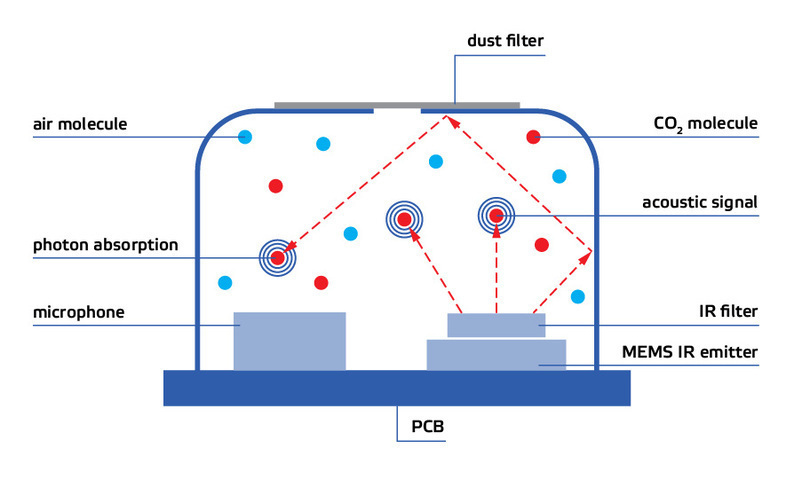
Higher CO2 concentrations result in stronger absorption of IR light, leading to more significant molecular vibrations and, consequently, larger pressure waves.
The acoustic signal detected by the microphone is processed by the sensor's electronics. The signal's amplitude is analysed to determine the CO2 concentration. Advanced algorithms are used to filter out noise and ensure accurate measurements.
PAS sensors represent a powerful tool for monitoring CO2 levels across various applications. They are ideal for environmental monitoring, indoor air quality assessment, greenhouse management, and industrial applications.
The Sentera CO2 room sensors all use this type of sensing technology.
Advantages of PAS sensors
PAS sensors have minimal interference of other gases, high sensitivity, rapid response time, and a wide dynamic range.
Another major advantage is the possibility to create a compact and portable design. In contrast with NDIR sensors, the design of PAS sensors is not sensitive to the precise alignment of optical components. Sound waves are omnidirectional, meaning the relative positioning of the IR emitter and the microphone is not as critical. This makes photoacoustic sensors suitable for applications where space is limited and makes them also more robust to mechanical and thermal stresses. They can be highly sensitive to small changes in CO2 concentration, providing accurate readings even at low concentrations.
PAS sensors have minimal interference of other gases, high sensitivity, rapid response time, and a wide dynamic range.
Another major advantage is the possibility to create a compact and portable design. In contrast with NDIR sensors, the design of PAS sensors is not sensitive to the precise alignment of optical components. Sound waves are omnidirectional, meaning the relative positioning of the IR emitter and the microphone is not as critical. This makes photoacoustic sensors suitable for applications where space is limited and makes them also more robust to mechanical and thermal stresses. They can be highly sensitive to small changes in CO2 concentration, providing accurate readings even at low concentrations.
Sensor calibration and sensor drift
Over time, a gradual deviation of a sensor’s output from the true or expected value will occur. This is called sensor drift.
All Sentera sensors use the Automatic Baseline Correction (ABC), a self-calibration algorithm that corrects sensor drift in typical indoor environments. The algorithm assumes that CO2 concentrations will drop to outside ambient conditions at least once in a 7-day period for 15 minutes or longer.
This situation typically occurs when the room is unoccupied and this low level is considered fresh outside air with a CO2 concentration of ±400 ppm (the baseline). This algorithm eliminates the need to manually recalibrate the sensors.
Sentera CO2 sensors are thus maintenance-free and have an exceptionally long life expectancy.
Learn more about the different types of gas sensing technologies in this review paper by D. Popa and F. Udrea from the University of Cambridge.