

What is the difference between CO and CO2?
Carbon monoxide (CO) and carbon dioxide (CO2) are often confused. After all, both gases consist of carbon and oxygen, and they are commonly associated with combustion and air quality. However, they differ significantly in chemical properties, toxicity, and their effects on health and the environment.
Understanding their differences can be life-saving!
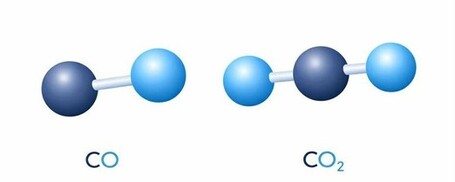
CO vs CO2
CO or carbon monoxide is produced when incomplete combustion of hydrocarbon fuels occurs due to insufficient oxygen supply, inefficient combustion, or engine malfunction. CO is a highly toxic gas that can pose serious health risks even at low concentrations.
Effect of CO
In the bloodstream, CO binds to the iron atom (Fe2+) of haemoglobin (Hb), the protein in red blood cells that normally carries oxygen to tissues and organs. CO binds over 200 times more strongly than O2, forming carboxyhaemoglobin (COHb). Oxygen can not bind effectively to haemoglobin, which impairs oxygen transport. In addition, the presence of CO makes the remaining O2 bind more tightly. As a result, the amount of oxygen delivered to tissues and organs is significantly reduced, leading to chemical asphyxiation, and potentially organ failure and death.
Depending on the CO concentration and duration of exposure, symptoms such as headaches, dizziness, nausea, confusion, shortness of breath, and loss of consciousness can occur.
Worldwide, thousands of people die each year from CO poisoning.
CO2 or carbon dioxide is a naturally present greenhouse gas, essential for life on Earth, and a natural by-product of both metabolic processes in living organisms and combustion. Humans and animals exhale CO2 when they breathe, while plants use CO2 to grow through photosynthesis. CO2 is also released when burning fossil fuels. Over the past decades, human activities have dramatically increased the amount of CO2 in the atmosphere, disturbing the natural balance and leading to global warming and climate change.
Effect of CO2
At high concentrations, CO2 can displace oxygen in the air, leading to oxygen deprivation and potentially suffocation. Excess CO2 in the bloodstream (hypercapnia) may cause respiratory acidosis.
Depending on the CO2 concentration and duration of exposure, symptoms such as headaches, drowsiness, reduced concentration, nausea, vomiting, and in extreme cases, loss of consciousness can occur.
WHO point of view
The World Health Organization (WHO) recognises CO as a hazardous indoor air pollutant and has established health-based exposure guidelines. The primary sources of indoor CO exposure are incomplete combustion processes, typically resulting from improperly installed, poorly maintained, or malfunctioning appliances using carbon-based fuels (e.g., gas, oil, coal, wood). Additional sources include blocked flues, short circuits, and indoor vehicle garages.
CO exposure may be acute or chronic. Acute exposure poses serious risks to the cardiovascular and neurological systems and can be fatal. Common symptoms of CO poisoning include headaches, dizziness, fatigue, nausea, drowsiness, disorientation, visual disturbances, shortness of breath and even coma.
WHO guidelines for indoor CO exposure, based on acute health effects, are:
- 100 mg/m³ (15-minute average)
- 35 mg/m³ (1-hour average)
- 10 mg/m³ (8-hour average)
- 7 mg/m³ (24-hour average)
For ambient outdoor air, the WHO recommends a 24-hour average limit of 4 mg/m³.
In contrast to CO, the WHO does not classify carbon dioxide (CO2) as an indoor air pollutant but rather as an indicator of ventilation adequacy, occupant load, and overall indoor air quality (IAQ). Consequently, no WHO health-based guidelines exist for CO2 as a pollutant. Nevertheless, health effects have been documented at concentrations below 5000 ppm, which are commonly encountered in non-occupational indoor environments.
Ambient outdoor air contains approximately 0.04% CO2 (≈ 400 ppm), whereas the air humans exhale contains about 4% CO2, a concentration roughly 100 times higher than the air inhaled. Indoor CO2 levels increase primarily due to human respiration and combustion of carbon-based fuels.
Current regulatory and scientific consensus commonly interprets indoor CO2 levels as follows:
- <1000 ppm: good IAQ
- 1000–1500 ppm: moderate IAQ
- >1500 ppm: poor IAQ
Overview
The table below presents a clear overview of CO and CO2 and summarises their main characteristics, sources, health and safety considerations, and environmental impacts.
|
|
Carbon monoxide (CO) | Carbon dioxide (CO2) |
|
Chemical formula
|
CO | CO2 |
|
Chemical composition
|
1 carbon atom + 1 oxygen atom | 1 carbon atom + 2 oxygen atoms |
|
Molecular weight
|
28 g/mol | 44 g/mol |
|
Natural prevalence
|
Generally not present in significant amounts in ambient air | Naturally occurring greenhouse gas, essential for life on Earth |
|
Reference level
|
< 0.1 ppm (global background, very low) | ± 400 ppm (0.04%) in outdoor air |
| Typical sources |
Incomplete combustion of carbon-containing fuels
(with limited oxygen supply)
|
Complete combustion of carbon-containing fuels;
Respiration (animals & humans);
Decomposition, fermentation, and other natural or industrial processes
|
|
Location
|
Near roads and parking areas (exhaust of motor vehicles)
Indoors (combustion sources such as cooking and heating)
|
Poor ventilation in confined spaces |
|
Environmental impact
|
CO is not a major greenhouse gas;
Any environmental effects are local (e.g. smog formation) rather than global warming
|
CO2 is the main anthropogenic greenhouse gas;
High atmospheric concentrations contribute to global warming and climate change
|
|
Gas properties
|
Colourless, odourless, and tasteless | Colourless and odourless |
|
Reactivity
|
Flammable, can form explosive mixtures with air | Non-flammable, not explosive |
|
Toxicity
|
Highly toxic, even at low concentrations | Only toxic at high concentrations |
| Mechanism of action |
Forms carboxyhaemoglobin (COHb) in the blood
Reducing/preventing oxygen transport Leads to chemical asphyxiation |
Displaces oxygen in the air
Oxygen deprivation and suffocation Leads to respiratory acidosis |
| Health effects |
Low-level exposure (tens of ppm): headaches, dizziness, nausea, fatigue;
Moderate exposure (hundreds of ppm): confusion, shortness of breath, impaired coordination, rapid heartbeat;
High or longer exposure: loss of consciousness, brain damage, death
|
Moderate to high levels can cause drowsiness, headaches, reduced concentration and fatigue;
Higher concentrations may induce nausea, dizziness and vomiting;
In extreme cases, breathing problems and loss of consciousness can occur
|
| Indoor safety limits |
15 minutes ~ 100 mg/m3
60 minutes ~ 35 mg/m3
8-hour ~ 10 mg/m3
24-hour ~ 3 mg/m3
|
Maximum ~ 5000 ppm
8-hour ~ 1500 ppm
24-hour ~ 1000 ppm
Levels between 400–1000 ppm are considered acceptable
|
In conclusion, while both CO and CO2 are potentially deadly, this happens at vastly different concentrations. A CO concentration of 35 ppm (0.4%) can be quickly life-threatening, in contrast, it takes more than 30 000 ppm (3%) of CO2 to reach the same risk level.
Early identification of life-threatening risks can be life-saving!