

What is differential pressure?
Differential pressure is the difference in air pressure between two distinct points in a ventilation or HVAC system. It is the driving force behind airflow: air naturally moves from areas of higher pressure to areas of lower pressure. Differential pressure is one of the most important parameters in ventilation systems. It is typically measured across a component such as a fan or an air filter and helps assess filter condition, airflow, and air velocity. By continuously monitoring the pressure difference, HVAC systems can maintain optimal airflow, improve energy efficiency, and ensure healthy indoor air quality and overall system performance.
Air filter monitoring
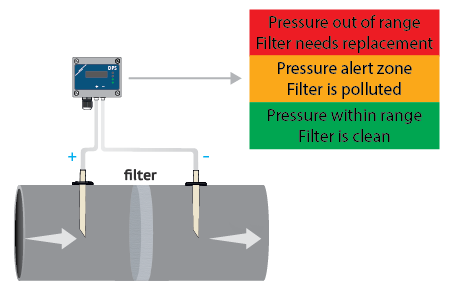
One major application of differential pressure is air filter monitoring. As air passes through a filter, it creates a pressure drop. A clean filter offers little resistance, resulting in a low differential pressure. As dust and particles accumulate, airflow becomes more restricted and the pressure difference increases.
By monitoring this pressure difference, clogged filters can be detected before they affect system performance. Cleaning or replacing filters at the right time improves indoor air quality, reduces energy consumption, and helps prevent unnecessary wear on fans.
Airflow measurement
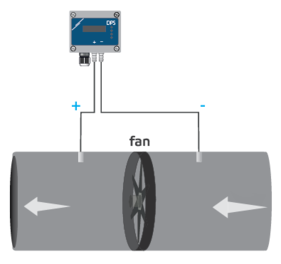
Airflow is the movement of air particles, pushed from a zone of high to a zone of lower air pressure. In ventilation systems, fans create a pressure difference to drive air through the ducts to supply fresh air in the building. Measuring the differential pressure across a fan — or another airflow measuring device — makes it possible to estimate the airflow rate or air volume flow and to verify that the ventilation system is delivering the required amount of fresh air.
Air volume flow can be calculated either based on the cross-section of the air duct or the K-factor of the fan. A larger cross-section allows more air to flow. The K-factor, on the other hand, is a constant that links the airflow through a fan to the pressure it produces — essentially describing how much air a specific fan moves for a given pressure difference. Each fan has its own K-factor, which can usually be obtained from the supplier.
Air velocity measurement
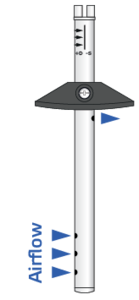
Air velocity describes how fast air is moving. When combined with a Pitot tube, a differential pressure sensor measures the velocity pressure of the moving air. From this value, the air velocity and air volume flow can be calculated, making it a reliable method for commissioning, balancing, and monitoring ventilation systems.
The Pitot tube has two openings: one facing directly into the airflow, which captures the total (impact) pressure, and one on the side, which senses the static pressure of the air. The difference between these two pressures is called velocity pressure, and it provides a measure of how fast the air is moving. Once the air velocity is known, the air volume flow can be calculated if the size of the air duct is known.
How do differential pressure sensors work?
A differential pressure sensor always has two connection points, called 'nozzles', allowing the air to flow over the electronic sensor element. Therefore, it is very important that the measured air is clean and free from corrosive elements.
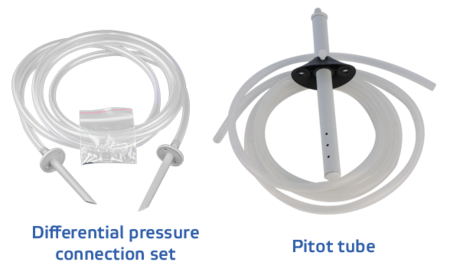
The nozzles can be connected either to a normal connection set (plastic tubes) or either to a Pitot tube:
Pitot tube
When a pitot tube is connected to the differential pressure sensor, the air velocity can be calculated. The sensor uses the measured differential pressure and the diameter of the air duct to calculate the air velocity.
Connection set
When a connection set is connected to the differential pressure sensor, either the differential pressure or the air volume flow can be calculated.
A connection set consists of two plastic fittings that are easily mounted in an air duct. These fittings are also connected to the differential pressure sensor using a transparent air hose. If the fan's K-factor is unknown, the air volume flow can be calculated in another way. Based on the air velocity (measured by a pitot tube) and the air duct diameter, the differential pressure sensor can calculate the airflow rate.
Differential pressure devices
Sentera's product range is divided into differential pressure relays, sensors, and controllers. Relays and sensors measure differential pressure, while controllers maintain the differential pressure constant at the desired setpoint by regulating a fan or a damper.
A pressure relay is a very simple device that detects whether the differential pressure is higher or lower than a certain value. It does not provide an accurate measurement, it only indicates whether the it exceeds the switching point or not. It operates mechanically and therefore requires no power supply to function. The switching point can be adjusted using a screwdriver.
A differential pressure sensor measures the differential pressure and transmits it via the analogue output signal (typically 0–10 V or 0–20 mA) and via Modbus RTU communication (if available).
A differential pressure controller works differently than a sensor. It allows to define a setpoint — the desired differential pressure or the desired amount of airflow — which can be adjusted via Modbus RTU communication. The controller generates an analogue output signal (typically 0–10 V or 0–20 mA) to keep the differential pressure equal to this setpoint.
The controller regulates fan speed or the position of the damper blade. If the differential pressure is too low, fan speed must increase to create more airflow or the damper must close to let less air pass through to build up more pressure and to maintain the desired differential pressure.
In conclusion, differential pressure measurement is an essential tool for ensuring that ventilation systems work as intended — quietly, continuously, and effectively safeguarding the comfort and well-being of building occupants. In practice, this means healthier indoor air quality, optimised system efficiency, and reduced operational costs.