Do CO2 sensors need (re)calibration?
Sentera CO2 sensors do not require recalibration when the self-correcting ABC algorithm is activated.
Sensor drift
All gas sensors experience a certain degree of drift over time, including CO2 sensors. Even with high-quality components and robust design, small deviations can occur, due to aging of the components — such as the IR source, detectors, or optical filters — contamination of optical paths, or changes in sensor electronics.
Manual recalibration is straightforward but time-consuming and can become quite costly if required frequently. Sentera CO2 sensors have an algorithm that performs corrections automatically, minimizing maintenance and extending sensor lifetime.
Automatic Baseline Correction (ABC) algorithm
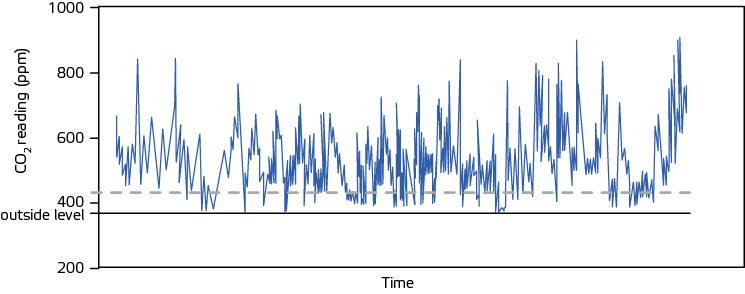
In typical indoor environments, Sentera CO2 sensors operate maintenance-free thanks to their built-in Automatic Baseline Correction (ABC) algorithm. This feature is enabled by default and is designed for applications where CO2 concentrations drop to outside ambient conditions at least once every 7 days for a minimum of 15 minutes, which is typically seen during unoccupied periods. The lowest CO2 concentration is assumed to represent fresh outside air (approximately 400 ppm), which serves as the baseline. After collecting several minimum values, the sensor performs a statistical self-check. If drift is detected, a correction factor is applied to restore accuracy.
However, when the sensor is installed in environments where CO2 levels never drop to ambient conditions — such as 24/7 occupied spaces, hospital rooms, police headquarters, or security offices — the ABC algorithm should be disabled via Modbus Holding Register 40. In such cases, manual correction or recalibration is required.
Manual drift correction
When automatic baseline correction is not suitable, the sensor can be corrected manually on regular basis. The more the sensor is corrected, the more accurate the readings will be.
The simplest method is to ventilate the room (e.g. by opening a window) until levels return to outdoor baseline levels, then temporarily enable the ABC algorithm for a few hours.
Alternatively, the sensor can be temporarily relocated to an environment where CO2 concentrations reliably drop to ambient levels. After correction, the sensor can be returned to its original location. However, this manual approach is time-consuming and less practical for frequent maintenance.